Vasco
Designing an AI research orchestrator for RevOps
Role
Founding Designer
Timeline
2022–2026
Location
Montréal
The Problem
RevOps teams sit on mountains of data. What they lack is the ability to turn it into a narrative fast enough to matter.
The synthesis work is manual and slow. The same numbers need to tell different stories depending on the audience: the board wants an executive summary, the VP Sales wants a pipeline diagnostic, the CRO wants concrete actions.
Some teams don’t even know where to start. They open a spreadsheet, stare at the numbers, and ask: “What’s going on?”
Existing tools don’t solve this. Dashboards show numbers, not narratives. Chat-based LLMs are stateless, so nothing persists. Slides are an output, not an analysis process.
Review Hub
Review Hub turns raw data into narratives (executive summaries, pipeline diagnostics, action plans) through guided AI conversation.
Our first direction was chat → outline → slides. Too fast. We were jumping straight to the output without doing the analysis work.
The real need wasn’t “make me slides.” It was the entire upstream analysis that nobody does well because it takes too long.
New architecture: guided conversation → analysis tasks → supporting assets → communication artifact.
Conversation over configuration
The natural instinct was filters and formulas. But a conversation is more flexible than any system of configuration. In a few questions, the AI extracts exactly what the user needs.
I use AI this way myself, asking it to interview me to clarify my thinking. That’s the pattern behind Review Hub: what we already do with LLMs, but structured and traceable.
Show me Q4 2025 pipeline for Enterprise and Mid-Market segments in EMEA or AMER where win rate is above 25%.
Trust before execution
Inspired by Cursor’s plan mode. Before the AI executes anything, it proposes a structured plan. The user reviews and approves. Handshake between machine and human. No surprises.
Building artifacts is expensive: time, compute, AI credits. Better to invest 30 seconds in a good plan than 5 minutes in a bad result.
The same principle applies during execution. The AI encounters decision points that need human judgment. Rather than guessing, it asks. Which pipeline definition? What geographic scope? How deep to dig?
The agency spectrum
Precise
Exact parameters
“QBR Q4, focus pipeline EMEA, compare year over year.”
Vague
Open question
“What’s going on with our sales?”
Serendipity
Full delegation
“Explore and tell me what you find interesting.”
Pulse
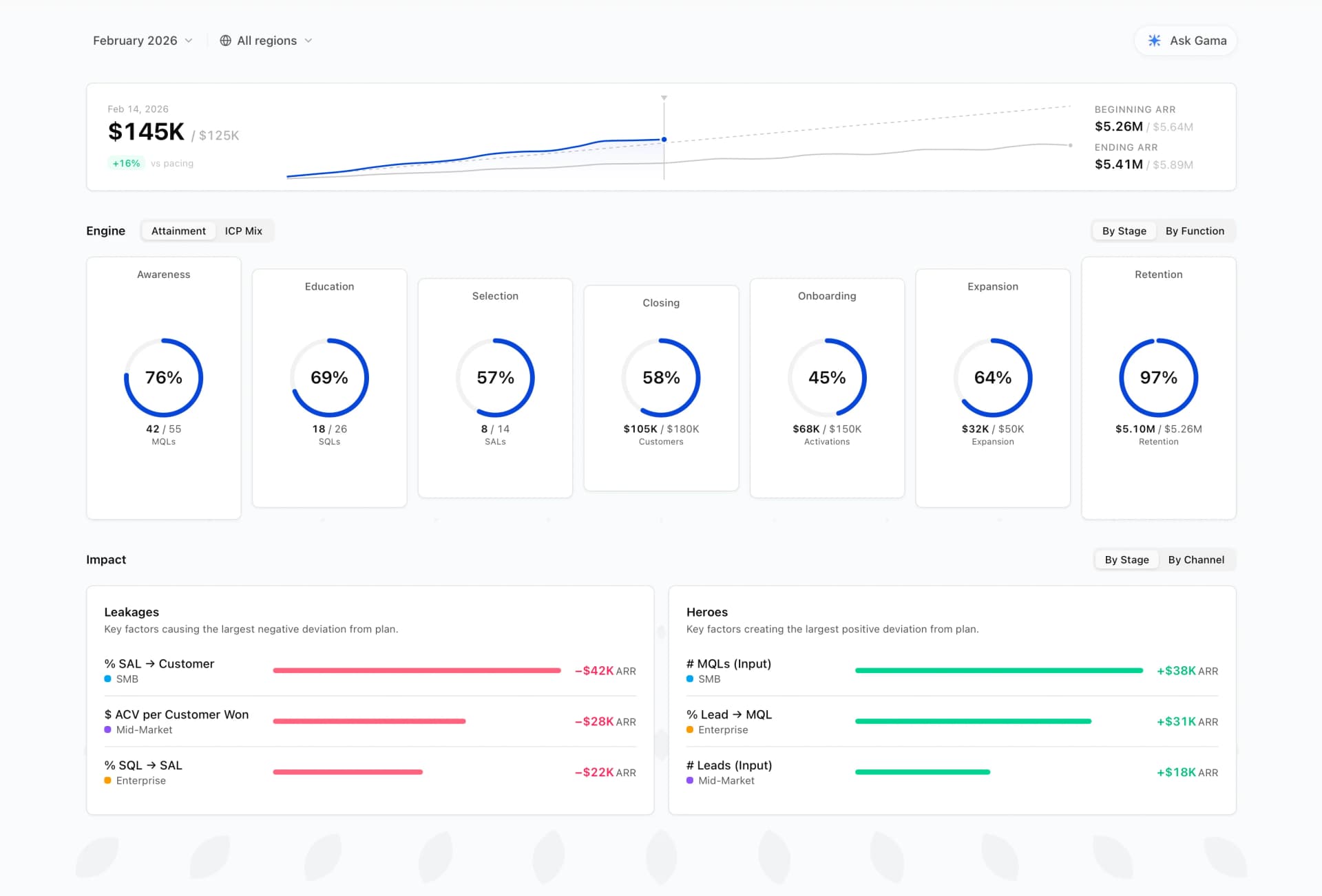
Revenue operations exists to align marketing, sales and customer success. Every function reads the funnel differently, and no single view unified them.
Pulse puts the entire revenue engine in one view. I shaped it with the CEO. It was one of the hardest features to get right: dense data, competing needs across functions, endless edge cases in how teams read their funnel.
It paid off. Pulse has the highest adoption and retention of any feature we’ve built, and it’s the one users come back to most.
Reflection
I joined Vasco as the first employee. No product, two founders with a Lightspeed exit, and a precise vision for what RevOps could be. I moved from Paris to Montréal for this bet.
I was the sole designer for two and a half years, working alongside engineers and two founders who care deeply about craft. Intense, but I loved it. The team has since grown. Two very good designers have joined, and I trust them to hold the bar we’ve set together.
Designing AI products means designing a boundary. The machine is good at analysis and speed. Humans are better at judgment and business context. Task approval and human-in-the-loop are two expressions of that same line.
Most of the hard work isn’t the interface. It’s deciding what the machine should do alone and where it needs a human to make the call.